Hidden in Plain Sight: A New Weapon Against Antimicrobial Resistance
The ability of bacteria to evade antibiotics is remarkably diverse. Some produce enzymes such as β-lactamases that degrade antibiotics before they can act, while others modify the molecular targets recognized by these drugs, preventing effective binding. Efflux pumps actively remove antibiotics from bacterial cells, reducing intracellular drug concentrations, whereas alterations in membrane permeability restrict antibiotic entry. Many pathogens also form biofilms, creating protective microbial communities that are highly tolerant to both antimicrobial agents and host immune responses. Through mutations and horizontal gene transfer, these resistance mechanisms can rapidly spread between bacterial populations, accelerating the emergence of multidrug-resistant pathogens.
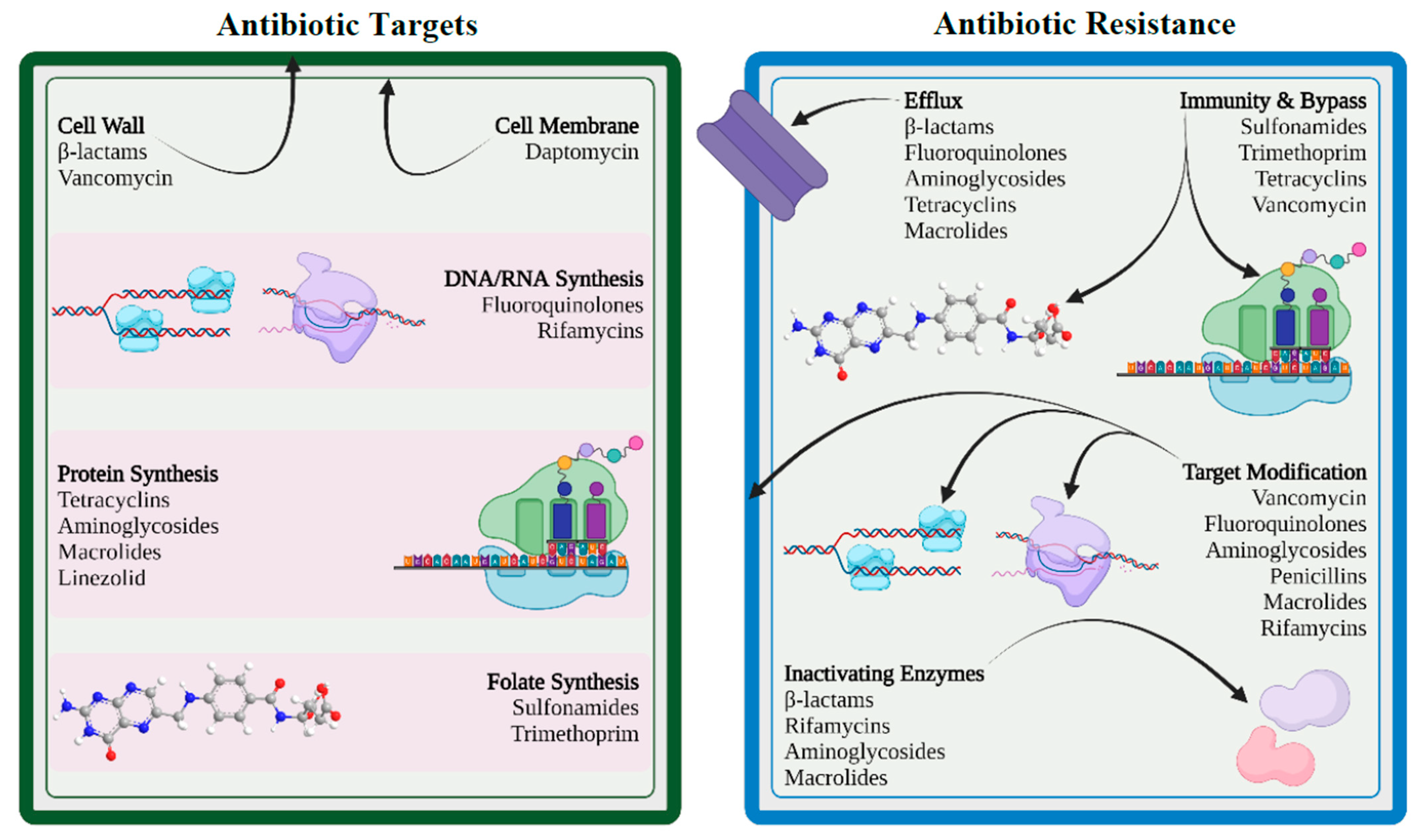 |
| Overview of antibacterial drug targets and the adaptive pathways that promote antibiotic resistance. |
While bacteria continue to evolve, antibiotic discovery has struggled to keep pace. The majority of clinically important antibiotic classes were discovered during the so-called Golden Age of antibiotic research between the 1940s and 1960s, with natural products from soil microorganisms serving as one of the richest sources of these compounds. Over time, however, researchers repeatedly isolated known molecules, leading to the widespread belief that many antibiotic-producing microorganisms had already revealed most of their chemical diversity. As a result, the discovery of antibiotics with entirely new mechanisms of action has become increasingly uncommon.
Interestingly, recent advances in analytical chemistry and natural product discovery are beginning to challenge this assumption. Rather than searching for entirely new microorganisms, researchers have started revisiting familiar antibiotic producers using improved screening technologies capable of detecting metabolites that may have escaped earlier investigations. A recent study provides an excellent example of this approach through the discovery of a previously unknown antibiotic, manikomycin. The researchers focused on Streptomyces rimosus, a soil-dwelling actinomycete that has been studied for more than seventy years and is widely known as the producer of oxytetracycline. Given its long history in antibiotic research, one might assume that this microorganism had little novelty left to offer. However, by screening 255 actinomycete extracts using bioactivity-guided fractionation and metabolomic analysis, the researchers identified a hidden antibacterial compound that had remained undetected despite decades of investigation.
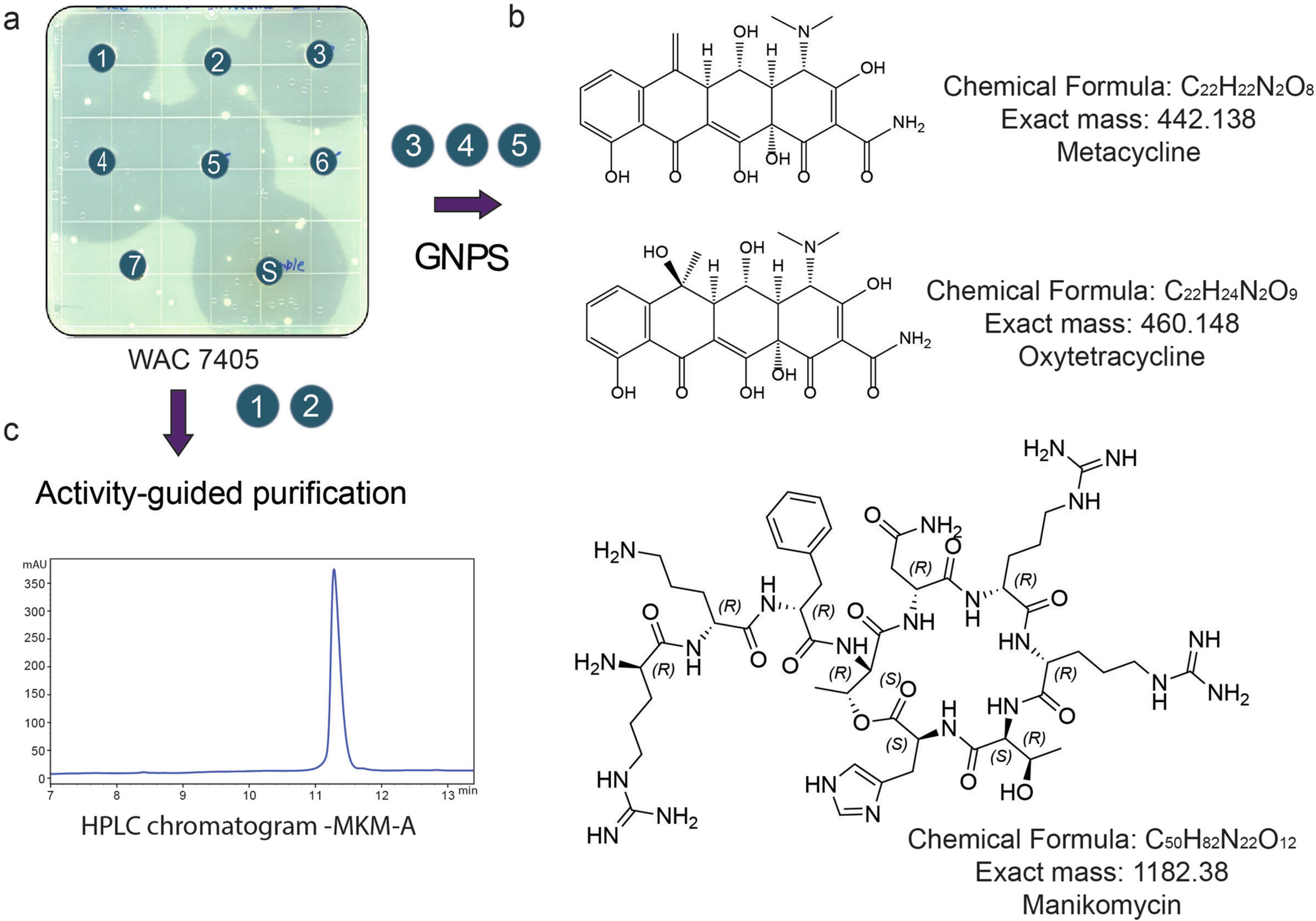 |
| Identification and purification of manikomycin from Streptomyces rimosus using activity-guided screening. |
The newly discovered molecule was named manikomycin, derived from the Hindi and Punjabi word "manik," meaning precious gem. Structural characterization revealed that it belongs to a previously unknown family of cyclic depsipeptides synthesized through non-ribosomal peptide synthetases. The identification of an entirely new natural product scaffold was particularly significant, as structurally unique molecules often interact with biological targets in unexpected ways and may avoid the resistance mechanisms that compromise existing antibiotics.
Initial antimicrobial testing demonstrated that manikomycin possesses activity against several clinically relevant Gram-negative pathogens, including multidrug-resistant members of the Enterobacteriaceae family. However, the most remarkable aspect of the compound was not simply its antibacterial activity but the mechanism through which it inhibited bacterial growth.
Protein synthesis represents one of the most common targets for antibacterial therapy. The bacterial ribosome functions as a complex molecular machine that translates genetic information into proteins required for cellular growth and survival. During translation, transfer RNAs move sequentially through three functional regions of the ribosome known as the aminoacyl (A), peptidyl (P), and exit (E) sites. Several successful antibiotic classes interfere with this process by targeting different ribosomal regions. Aminoglycosides disrupt decoding, tetracyclines prevent tRNA binding, and macrolides block the peptide exit tunnel. Unfortunately, decades of clinical use have enabled bacteria to evolve resistance mechanisms against many of these established targets.
The researchers therefore sought to determine whether manikomycin exploited a different vulnerability within the bacterial ribosome. High-resolution cryo-electron microscopy provided an unexpected answer. Rather than binding to previously characterized antibiotic-binding sites, manikomycin specifically interacted with the E-site of the bacterial ribosome. This region had not previously been targeted by clinically relevant antibacterial agents.
 |
| Cryo-EM structure showing manikomycin binding to the E-site of the bacterial ribosome. |
This discovery was particularly intriguing because of the role played by the E-site during translation. As protein synthesis progresses, transfer RNAs move from the A-site to the P-site and finally to the E-site before exiting the ribosome. Structural analysis demonstrated that manikomycin occupies this region and interferes with the proper positioning of the transfer RNA, particularly its CCA terminus. By disrupting this essential movement, the antibiotic effectively stalls ribosomal translocation and inhibits protein synthesis. Further experiments revealed that the effects of manikomycin were not entirely uniform across all translating ribosomes. Ribosome profiling demonstrated context-dependent inhibition, with stronger translational pausing observed at certain codons than others. These findings not only provided additional insights into the mechanism of action of the antibiotic but also improved our understanding of the dynamic process of bacterial translation itself.
The researchers also investigated how the producer organism protects itself from its own antibiotic. Like many antibiotic-producing microorganisms, S. rimosus possesses a self-resistance mechanism encoded within the manikomycin biosynthetic gene cluster. A methyltransferase known as ManE chemically modifies a specific nucleotide within ribosomal RNA, subtly altering the E-site architecture and reducing manikomycin binding while preserving normal ribosomal function. Structural studies confirmed that this modification provides effective self-protection without significantly affecting protein synthesis.
 |
| Adaptive mutations and transporter proteins influence bacterial resistance to manikomycin. |
Having established the molecular mechanism of the compound, the researchers next evaluated its therapeutic potential. Manikomycin demonstrated promising antibacterial activity against several multidrug-resistant Enterobacteriaceae, including clinically important strains of Escherichia coli and Klebsiella pneumoniae. In an ex vivo human blood infection model, treatment with the antibiotic reduced bacterial numbers by approximately one thousand-fold after six hours of exposure at five times the minimum inhibitory concentration. The efficacy of the compound was further evaluated using a Caenorhabditis elegans infection model. Animals infected with multidrug-resistant Klebsiella pneumoniae and treated with manikomycin exhibited survival rates of approximately 55 to 60 percent, compared with only 10 to 30 percent in untreated controls. Interestingly, the protective effect was comparable to that achieved with polymyxin B, an antibiotic frequently reserved as a last-line treatment for multidrug-resistant Gram-negative infections.
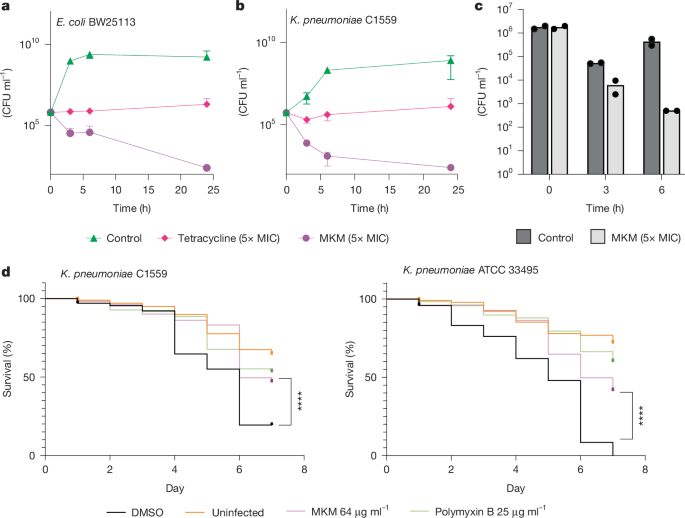 |
| Therapeutic evaluation highlights the antibacterial efficacy of manikomycin in vitro and in vivo |
Safety remains an important consideration during antibiotic development, particularly for peptide-based natural products. Encouragingly, the researchers observed no detectable haemolytic activity or significant toxicity against mammalian cell lines, including HEK293 and HepG2 cells, at concentrations up to 256 μg mL⁻¹. Furthermore, biochemical studies demonstrated that bacterial translation was inhibited far more effectively than mammalian protein synthesis, supporting the selective nature of the antibiotic.
Despite these encouraging findings, the researchers recognized that antibacterial activity alone does not guarantee clinical success. Initial mouse studies produced limited therapeutic efficacy, prompting further pharmacokinetic analysis. Although manikomycin displayed good plasma stability, it was rapidly cleared from circulation and exhibited a relatively short terminal half-life of approximately 36 minutes. These pharmacokinetic limitations likely restricted systemic exposure and reduced efficacy in vivo. Importantly, mice tolerated doses of up to 220 mg kg⁻¹ per day without evidence of acute toxicity, suggesting that future chemical optimization could improve pharmacokinetic properties while maintaining antibacterial activity.
Perhaps the most significant contribution of this study extends beyond the discovery of manikomycin itself. For many years, antibiotic research assumed that well-characterized microorganisms had already yielded their most valuable natural products. The identification of a completely new antibiotic scaffold from Streptomyces rimosus, a bacterium investigated for more than seven decades, challenges this assumption and demonstrates that familiar microorganisms may still harbor substantial unexplored chemical diversity. At the same time, the study highlights the importance of developing antibiotics with novel mechanisms of action. By targeting the E-site of the bacterial ribosome, manikomycin exploits a molecular vulnerability that has remained largely untouched by existing antibacterial therapies. Although further optimization will be required before clinical application becomes feasible, the discovery provides a promising framework for the development of future antibiotics capable of overcoming established resistance mechanisms.
As antimicrobial resistance continues to outpace the development of effective treatments, innovative discovery strategies will become increasingly important. The story of manikomycin suggests that the next breakthrough in antibiotic research may not necessarily come from unexplored environments or entirely new organisms, but from revisiting familiar microbial producers with modern analytical tools. In the ongoing battle against antimicrobial resistance, some of the most valuable discoveries may have been hidden in plain sight all along.
REFERENCES:
- Kaur, M., Travin, D. Y., Berger, M. J., Jangra, M., Morici, M., Safdari, H. A., Klepacki, D., Wang, W., Cook, M., Chou, S., Guitor, A. K., Koteva, K., Xu, M., Ejim, L., Fiebig, A., Yousefi, Y., Coombes, B. K., Macneil, L., Vázquez-Laslop, N., Mankin, A. S., … Wright, G. D. (2026). A natural depsipeptide antibiotic binds the E-site of the bacterial ribosome. Nature, 10.1038/s41586-026-10589-2. Advance online publication. https://doi.org/10.1038/s41586-026-10589-2
- Salam, M. A., Al-Amin, M. Y., Salam, M. T., Pawar, J. S., Akhter, N., Rabaan, A. A., & Alqumber, M. A. A. (2023). Antimicrobial Resistance: A Growing Serious Threat for Global Public Health. Healthcare (Basel, Switzerland), 11(13), 1946. https://doi.org/10.3390/healthcare11131946
IMAGE SOURCES:
- BioProcess International, https://eu-images.contentstack.com/v3/assets/blt0a48a1f3edca9eb0/blt567c631597a4b96c/693740cfd28346c8c3079e7f/AdobeStock_176740754.jpg?disable=upscale&width=1200&height=630&fit=crop
- MDPI, https://www.mdpi.com/healthcare/healthcare-11-01946/article_deploy/html/images/healthcare-11-01946-g002.png
- Nature, https://media.springernature.com/lw685/springer-static/esm/art%3A10.1038%2Fs41586-026-10589-2/MediaObjects/41586_2026_10589_Fig7_ESM.jpg?
- Nature, https://media.springernature.com/lw685/springer-static/image/art%3A10.1038%2Fs41586-026-10589-2/MediaObjects/41586_2026_10589_Fig3_HTML.png?
- Nature, https://media.springernature.com/lw685/springer-static/image/art%3A10.1038%2Fs41586-026-10589-2/MediaObjects/41586_2026_10589_Fig2_HTML.png?
- Nature, https://media.springernature.com/lw685/springer-static/image/art%3A10.1038%2Fs41586-026-10589-2/MediaObjects/41586_2026_10589_Fig6_HTML.png?


Comments
Post a Comment